

SEO and Online Authority for Financial Advisors
Your firm may have experienced advisors, strong planning expertise, and a pretty clear idea of the clients you want to work with. The question is whether your website makes that obvious.
Can a potential client understand what you do, who you’re best suited to help, and why they should trust you? And can Google, an AI search system, or someone researching you after a referral find enough consistent information to reach the same conclusion?
That’s the kind of work we help with.
ModSquare works with independent financial advisors, RIAs, and wealth management firms to improve search visibility, strengthen the website, build better content, and make the firm’s expertise easier to understand.
SEO is a big part of that. It just isn’t the whole thing.
Getting Found Is Only the First Part
A potential client might find you through Google, Maps, an AI-generated answer, or a referral. They may already have your name and simply be checking you out before they call.
Once they reach your website, the job changes. Now you need to earn trust.
This is where I think a lot of advisor websites come up short. The firm may have excellent advisors with decades of experience. They may do really thoughtful work for retirees, business owners, widows, executives, or high-net-worth families. But sometimes you would barely know it from the website.
The service pages are thin. The bios read like résumés. The content is generic. The firm says it is comprehensive, personalized, holistic, and client-focused, but so does everybody else.
In a lot of cases, the expertise is already there. The website just isn’t doing a very good job of showing it.
Search creates the opportunity to be discovered. The website has to do the rest.
Financial Advisor SEO Is Bigger Than Keywords
Keywords still matter because they tell us how people search, which services they care about, and how they describe their problems. But we’re not trying to build a website around a spreadsheet of keywords.
We’re trying to make the business easier to understand.
What do you actually help with? Who are you really best suited to serve? Which markets matter? What do your advisors know especially well? What evidence exists that backs all of that up?
A retirement-planning firm should probably look different online from a general wealth-management firm. A practice built around business owners should probably look different from one focused on widows or physicians. A local advisory firm needs a different geographic strategy from a national virtual firm.
And if you have several advisors, offices, services, and specialties, the website needs to make those relationships clear.
That’s really the bigger job. Not just putting the keyword on the page.


Your Website Is Only One Part of the Picture
Prospects rarely evaluate an advisory firm in one place anymore.
They may look at your website, Google Business Profile, IAPD or BrokerCheck, CFP Board profiles, reviews, advisor directories, local or industry publications, social profiles, AI-generated answers, and anything else that appears when they search your name.
Those sources don’t all work the same way, but they should tell a reasonably consistent story.
Who are you? What do you do? Who do you help? Where do you work? Who are the people behind the firm? What gives them credibility?
That consistency matters for people, and increasingly it matters for search and AI systems too.
This is one of the reasons I don’t think of SEO as a bunch of separate tricks. The stronger the overall body of evidence around the firm becomes, the easier it is for both people and machines to understand what the business is actually about.
What We Actually Work On
Every firm is a little different.
Sometimes the website looks great, but there’s almost nothing behind the main services. Sometimes the advisors have decades of experience and you’d never know it from their bios. Other times, the firm ranks fairly well locally but hasn’t given Google much reason to see it as relevant anywhere beyond that immediate market.
That’s usually where we start: What’s already working? What’s missing? And what would actually be worth improving?
-

Core Services and Website Structure
The website should reflect the business as it exists today. That sounds obvious, but it’s surprisingly common for the website to lag several years behind the firm.
Maybe retirement planning has become a major service, but it still shares half a page with everything else. Maybe the firm now serves several distinct client groups, but none of that is reflected in the site structure. Maybe there are too many overlapping pages that all say roughly the same thing.
I don’t think every service or keyword needs its own page. If the service matters to the business and a potential client would genuinely benefit from having a page about it, great. If we’re creating the page mostly because an SEO tool told us there was a keyword, I’m usually a lot less interested.
-

Advisor Expertise
For financial advisors, the people matter.
A good advisor bio should tell me more than where someone went to school and which letters come after their name. What are they especially good at? Who do they work with? What kinds of problems have they spent years helping people solve? What role do they play inside the firm?
The goal isn’t to turn every bio into a giant essay. It’s to make the expertise behind the advice easier to see.
-

Educational Content
I’m also a big believer in useful educational content when it supports something the firm actually wants to be known for.
If retirement planning matters, that might mean answering questions about Roth conversions, Social Security, retirement income, Medicare, inherited accounts, or old 401(k)s. If business owners are important, the content should probably reflect the decisions business owners are actually dealing with.
The point is not to publish four blog posts every month because somebody sold you a content package. The point is to create useful material that demonstrates what your firm really knows.
-

Local and Regional Visibility
For many advisory firms, geography still matters quite a bit.
That may involve Google Business Profile work, stronger location information, reviews, local service relevance, or better connections between services, advisors, and offices.
But I’m not a fan of creating 40 city pages just because a keyword tool gave us 40 city names.
I’d rather ask: Which markets are actually important to the business?
Then build around those.
From a Local Presence to Regional Visibility
One of the better examples of this came from an independent advisor we worked with in New York.
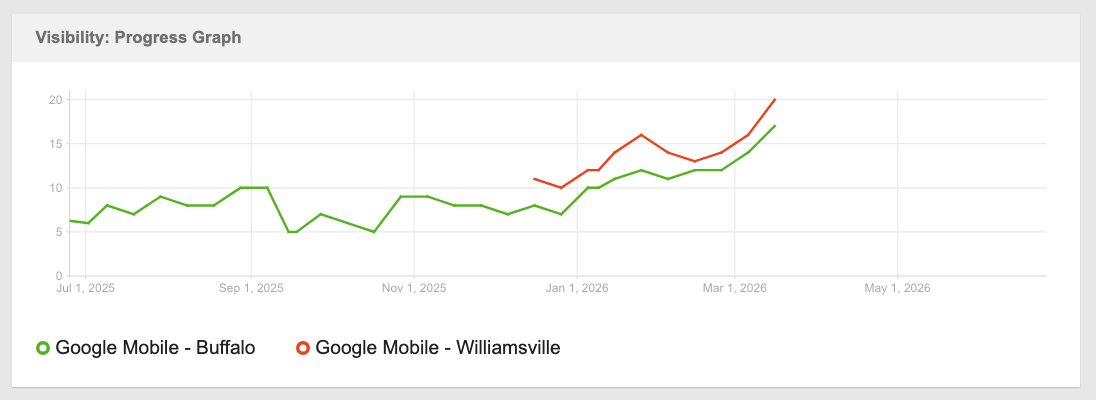
The website already had a decent foundation and reasonable visibility in the firm’s immediate local market. The bigger goal was Buffalo.
That meant competing against much larger advisory firms with deeper websites and much bigger content libraries. We did not try to solve that by creating dozens of pages all at once.
We strengthened the existing service pages, built deeper educational content around important planning topics, improved the internal linking, and gradually increased the site’s relevance to the Buffalo market.
Over the following 12 months, Google Search Console recorded 19,800 search impressions, and monthly impressions increased substantially toward the end of the period.
More importantly, Buffalo-related searches started becoming some of the site’s most visible queries. That included searches around retirement advisors, retirement planning, investment planning, financial planning, and financial advisors in Buffalo.
That was the part I cared about most.
A single ranking can move around. What was more meaningful was seeing Google increasingly connect the firm with the larger market we were trying to reach.


Should You Focus on Geography, Specialization, or Both?
It depends.
A firm that works mostly with retirees within 30 or 40 miles of one office may need strong local authority. A virtual firm focused on one profession or one financial situation may benefit far more from specialization. A multi-office wealth-management firm may need both.
So we look at where your clients actually come from, which clients you want more of, whether location matters in the buying decision, how competitive the market is, whether the firm has a real niche, and whether the website can support the structure without creating a bunch of repetitive content.
The strategy should follow the business. Not the other way around.
Financial Content Needs More Care
Financial content is different from writing about lawn care or kitchen cabinets.
People may use it to make decisions that affect retirement, taxes, investments, or their family’s financial future. So accuracy matters. Authorship matters. Review matters.
For important financial content, we generally want a qualified author or reviewer, reliable sources for factual or time-sensitive claims, human fact-checking, original advisor insight, review dates where information may change, appropriate disclosures, and review through the firm’s own compliance process.
AI can absolutely help with research, organization, and drafting. I use it too.
But it should not invent the firm’s experience, replace advisor judgment, or bypass human review.
Our job is to help make the content accurate, useful, clear, and easier to review. Final compliance approval still belongs with the firm and its authorized reviewers.


What About AI Search?
This is probably the question that has changed the most over the last couple of years.
People are increasingly asking AI tools for recommendations, explanations, comparisons, and answers that they once would have searched for in Google. That matters.
But I don’t think it means we need to throw out SEO and start over.
The same basic things still help: clear services, useful content, strong expertise, consistent business information, good local relevance, credible outside references, and a website that can actually be accessed and understood.
The difference is that AI systems may pull from several sources and assemble an answer rather than simply showing ten blue links. That makes authority and consistency even more important.
So we pay attention to AI discovery. We just don’t turn it into a separate pile of “GEO tricks.”
How We Work
We start with your business. What services matter most to you? Which clients do you want more of? Which markets really matter? What are your advisors especially good at? What is already working? What isn’t?
Then we look at the website, Search Console, rankings, competitors, advisor profiles, local visibility, content, technical issues, and outside authority. From there, we decide what is actually worth doing next.
Some months that may mean improving a core service page. Another month it may be local search, an advisor bio, internal linking, technical cleanup, educational content, or a new opportunity we found in the data.
We’re not trying to fix everything at once. I’d rather identify the few things that are most likely to matter and start there. Then we measure what happens and keep going.
That’s how the site gets stronger over time.
Common Questions
Will we need a new website?
Maybe, but probably not just because the current one is a few years old. Many advisor websites can be improved substantially with better structure, stronger service pages, clearer advisor information, better internal linking, technical fixes, and more useful content. If the current site is genuinely holding the business back, we’ll say so. But rebuilding the whole thing is likely not the answer.
How long does financial advisor SEO take?
There isn’t a universal timetable. Some things can move relatively quickly. Building meaningful visibility in a competitive market usually takes months of steady work. I tend to look for signs of progress along the way: better query alignment, stronger impressions, more visibility around important services and markets, ranking movement, and eventually qualified inquiries.
How does compliance affect the process?
It depends on the firm and its review process. We can help write and organize content so it is accurate, balanced, sourced, and easier to review. The final approval still belongs with your compliance resources.
Has AI made SEO obsolete?
Not at all. The way information gets presented is changing. The need for clear expertise, useful content, strong service pages, good technical foundations, local relevance, and outside credibility has not gone away. If anything, those things matter more.
Let’s Look at Where Your Firm Stands
Your website does not need to explain every single thing your firm knows.But it does need to give the right prospect enough information to understand what you do, why you may be relevant, and why they should trust you.
That’s what we help improve.
ModSquare has worked with financial-advisor firms since 2019, with increasingly deep involvement in SEO, website strategy, and online authority.
If you’d like, tell me a little about your firm, the clients you want to attract, and the services or markets you want to strengthen.
We can take a look and see if there’s a sensible next step.